Six Occupants, One Empty Chair: The Treasury Lessons Downing Street Kept Forgetting
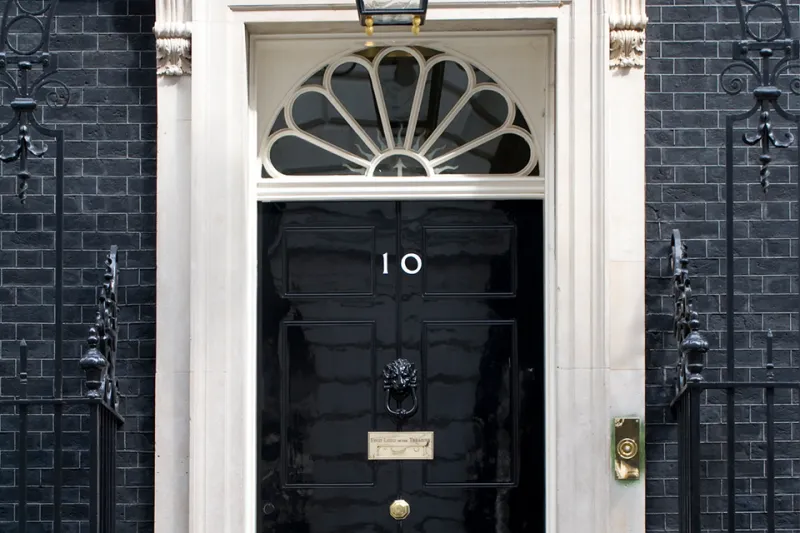
Photo: UK Government, OGL 3, via Wikimedia Commons
There is a particular silence that falls over Westminster whenever the subject of 2008 arises. Labour frontbenchers mention the global financial crisis in hushed, almost apologetic tones, as though saving the banking system were something to be embarrassed about. Their Conservative predecessors, meanwhile, built an entire decade of election campaigns on blaming it.
Both habits obscure a simpler truth: since Gordon Brown left Downing Street, every Prime Minister has faced a moment of genuine economic peril — and each has been measured, whether they like it or not, against how he handled the last one.
Cameron: Borrowing the Language, Rejecting the Logic
David Cameron's inheritance in 2010 was a deficit crisis, and his response was to invert Brown's playbook entirely. Where Brown had argued that a crisis demands the state lean in, the Coalition insisted it must step back. Yet even as George Osborne slashed departmental budgets, he quietly preserved the architecture Brown built: Bank of England independence, fiscal rules, the protection of health spending. It was, in effect, a governing programme conducted inside a settlement designed by his predecessor.
May: The Caution Without the Conviction
Theresa May governed through the slow-motion crisis of Brexit uncertainty. Her instinct — warn repeatedly that austerity had exhausted itself, then change almost nothing — captured the worst of both worlds. Brown's lesson was that a Chancellor must have a plan for the rainy day before it rains. May had the umbrella in her hand and never opened it.
Johnson: The Spender Who Wouldn't Count
Then came the pandemic, and with it the strangest fiscal irony of the era. Boris Johnson — the man who campaigned against 'Brown's borrowing' — ran a wartime budget larger than anything the Treasury had seen since 1945. And to be fair, the furlough scheme worked. It was, at its core, a very Brownian intervention: the state as insurer of last resort, moving fast, at scale.
What Johnson lacked was the discipline that gave such interventions credibility. Brown paired emergency spending with a credible path back; Johnson paired it with a Chancellor who thought the path back was a slogan.
Truss: The Stress Test That Failed
Liz Truss deserves her own paragraph only because she is the counter-argument to everything this site has ever argued. Forty-nine days. A fiscal statement that ignored the markets it was meant to reassure. The lesson of 2008 — that financial markets punish not just weakness but unexplained weakness — was available, written down, taught in every economics faculty in the country. It was not learned.
Sunak: The Technician Who Missed the Politics
Rishi Sunak was, on paper, the most competent steward of the lot. But competence without narrative is its own failure. Brown understood that in a crisis, a Prime Minister must tell the country a story about shared sacrifice and shared recovery. Sunak offered spreadsheets. The cost-of-living emergency demanded a Churchillian register; he delivered a customer-service voice.
Starmer: The Inheritance Test
Which brings us to the present occupant. Keir Starmer's challenge is the mirror image of 2010: he inherited a broken economy from his opponents rather than the reverse. His government's fiscal caution has been derided in some quarters as timidity. But Brown's own record suggests caution and ambition are not enemies — they are partners. You earn the right to transform by first proving you can be trusted.
The question for Starmer is whether he understands what that trust is for. A surplus is not an end in itself. Brown banked credibility in the good years to spend it on the NHS, on schools, on families. If this government treats prudence as the destination rather than the vehicle, it will have learned the mechanics of the playbook and missed its meaning entirely.
The Verdict
Sixteen years, six Prime Ministers, one unacknowledged teacher. Some borrowed the tools; some tripped over them in the dark. The measure of this Labour government will be whether it can finally admit whose playbook it is reading — and write the next chapter itself.